β-lactam antibiotics: overview
What penicillins, cephalosporins, carbapenems and monobactams have in common, from the ring that defines them to how bacteria resist them, the allergy patients fear and their use in pregnancy.
- 14 min read
- 6 questions
- Checked 26 Oct 2026
Contents8 sections
At a glance
- β-Lactams share a reactive four-membered ring, the β-lactam ring, of three carbons and a nitrogen. There are four families: penicillins, cephalosporins, carbapenems and monobactams.
- Most are water-soluble, stay outside cells and leave through the kidneys, many with half-lives of an hour or less.
- They bind and acylate the penicillin-binding proteins (PBPs), the enzymes that cross-link peptidoglycan. The weakened wall gives way and the bacterium bursts: they are bactericidal, but only to bacteria that are growing, and enterococci they only hold back. Their killing is time-dependent: what counts is how long the free drug stays above the minimum inhibitory concentration (fT>MIC), not how high it peaks.
- Bacteria resist them mostly with β-lactamases, enzymes that break the ring, above all in gram-negatives; also with PBPs they bind poorly (PBP2a of MRSA), the main way in gram-positives, and with fewer porins and efflux pumps. β-Lactamase inhibitors protect the drug they are paired with.
- Hypersensitivity is their main adverse reaction. About one patient in ten reports a penicillin allergy, but fewer than one patient in a hundred, of all patients, is truly allergic.
- Penicillins and cephalosporins are among the antibiotics of choice in pregnancy and in breastfeeding. Co-amoxiclav is the exception to know: it is avoided when the membranes rupture before term.
Drug classification
The β-lactam ring is a cyclic amide under strain, which makes its carbonyl reactive: this is what the PBP's serine attacks. In three of the families it is fused to a second ring, and the side chains hung on the two rings decide each drug's spectrum, its stability to β-lactamases and, for cephalosporins, much of its pharmacokinetics.
Penicillins
The ring fused to a five-membered thiazolidine ring, with sulfur (6-aminopenicillanic acid), and one side chain, R1.
- Penicillin Gnarrow spectrum
- Flucloxacillinpenicillinase-resistant
- Amoxicillinextended spectrum
- Piperacillinextended spectrum, antipseudomonal
Cephalosporins
The ring fused to a six-membered dihydrothiazine ring, with sulfur (7-aminocephalosporanic acid), and two side chains, R1 and R2.
- Cefazolinfirst generation
- Cefuroximesecond generation
- Ceftriaxonethird generation
- Cefepimefourth generation
- Ceftarolineadvanced generation
Carbapenems
The ring fused to a five-membered ring with carbon in place of sulfur.
- Imipenemwith cilastatin
- Meropenemused in meningitis
- Ertapenemonce a day
Monobactam
The ring stands alone.
- Aztreonamgram-negatives only
β-Lactamase inhibitors
Given only with a β-lactam, which they protect from β-lactamases (Pharmacodynamics, below).
- Clavulanic acidwith amoxicillin
- Sulbactamwith ampicillin
- Tazobactamwith piperacillin or ceftolozane
- Enmetazobactamwith cefepime
- Avibactamwith ceftazidime or aztreonam
- Relebactamwith imipenem
- Vaborbactamwith meropenem
The R1 side chain matters again in allergy: it, more than the shared ring, decides which β-lactams cross-react. Each family's own topic lists more of its drugs.
Pharmacokinetics
β-Lactams are water-soluble and spread through the fluid outside cells. They reach most tissues, the pleura, joints and urine well, but get into cells poorly. Into the cerebrospinal fluid they reach useful levels only when the meninges are inflamed, so meningitis is treated with high doses of the ones that cross best.
Most leave in the urine, filtered by the glomeruli and secreted by the tubules. Probenecid competes for that tubular secretion and raises their levels, and doses of most β-lactams are cut in kidney failure. The exceptions are cleared partly in bile: ceftriaxone, nafcillin and oxacillin among them. Most penicillins have half-lives under an hour, so they are given several times a day.
Pharmacodynamics
How they kill
Outside the plasma membrane, most bacteria build a wall of peptidoglycan: chains of two alternating sugars, N-acetylglucosamine and N-acetylmuramic acid, each muramic acid carrying a short peptide that, as it is made, ends in two D-alanines. Peptides on neighbouring chains are cross-linked into one mesh round the cell, which holds its shape against the pressure of the water inside.
- 1
Units are made inside
In the cytoplasm, each building block is assembled: the two sugars and the peptide ending in D-Ala-D-Ala. - 2
Carried across the membrane
A lipid carrier, bactoprenol, takes each unit across the plasma membrane. Bacitracin stops the carrier being recycled. - 3
Joined into chains
Outside the membrane, glycosyltransferases add each unit to the end of a growing sugar chain. Glycopeptides such as vancomycin bind the D-Ala-D-Ala end and block this step and the next. - 4
Cross-linked by PBPs
Transpeptidases, the PBPs, join a peptide to its neighbour, cutting off the last D-alanine. β-Lactams block them here.
The β-lactam ring looks to a PBP like the D-Ala-D-Ala end of its substrate. The enzyme's active-site serine opens the ring and is left acylated, a stable, inactive complex. New wall goes up without cross-links while the bacterium's own autolysins go on cutting the old wall to make room for growth, and the cell lyses. The last step is often taught as the drug inactivating an inhibitor of the autolysins. That holds in pneumococci, whose lipoteichoic acids hold back their main autolysin until penicillin sets it free; in other bacteria it is not settled whether anything sets the autolysins off or they simply carry on with their usual work. Enterococci are the exception: a β-lactam alone holds them back rather than kills them.
Step 1 of 6A PBP builds the wall. The PBP holds the D-Ala-D-Ala end of the newest chain’s peptide in its active site, beside a glycine bridge from the layer above.
Point at a name or a part to light it.
A gram-positive wall, after Staphylococcus aureus, whose peptides are joined by bridges of five glycines. Bacteria that a β-lactam stops from growing but kills far more slowly are called tolerant: often their autolysins fail.
Simplified: not to scale; two layers of old wall, where a real one has many; chains straight and peptides in the page’s plane, though they run every way; inside the wall, only the peptides that meet a partner drawn, and a glycine bridge on only some of them, though each peptide carries one; one PBP and one β-lactam, where a bacterium has several kinds of PBP and many drug molecules reach them; penicillin drawn as its two rings and side chain, its smaller groups left out; the autolysins drawn cutting only once cross-linking stops, though a growing wall needs them all along; whether a blocked PBP sets the autolysins off or they simply carry on with their usual work is not settled; the burst drawn at a hole in the side wall, though in staphylococci it opens where the cell starts to split; killing drawn as bursting, though a bacterium can die before it bursts, or without bursting.
11 sources
- Parker N et al. Microbiology. OpenStax, 2016. 3.3 Unique characteristics of prokaryotic cells
- Parker N et al. Microbiology. OpenStax, 2016. 14.3 Mechanisms of antibacterial drugs
- Vollmer W, Blanot D, de Pedro MA. FEMS Microbiol Rev 2008;32:149–67. Peptidoglycan structure and architecture
- Sauvage E, Kerff F, Terrak M, Ayala JA, Charlier P. FEMS Microbiol Rev 2008;32:234–58. The penicillin-binding proteins: structure and role in peptidoglycan biosynthesis
- Tipper DJ, Strominger JL. Proc Natl Acad Sci USA 1965;54:1133–41. Mechanism of action of penicillins: a proposal based on their structural similarity to acyl-D-alanyl-D-alanine
- Bush K, Bradford PA. Cold Spring Harb Perspect Med 2016;6:a025247. β-Lactams and β-lactamase inhibitors: an overview
- Vollmer W, Joris B, Charlier P, Foster S. FEMS Microbiol Rev 2008;32:259–86. Bacterial peptidoglycan (murein) hydrolases
- Papp-Wallace KM, Endimiani A, Taracila MA, Bonomo RA. Antimicrob Agents Chemother 2011;55:4943–60. Carbapenems: past, present, and future
- Cho H, Uehara T, Bernhardt TG. Cell 2014;159:1300–11. Beta-lactam antibiotics induce a lethal malfunctioning of the bacterial cell wall synthesis machinery
- Giesbrecht P, Kersten T, Maidhof H, Wecke J. Microbiol Mol Biol Rev 1998;62:1371–414. Staphylococcal cell wall: morphogenesis and fatal variations in the presence of penicillin
- Tuomanen E, Durack DT, Tomasz A. Antimicrob Agents Chemother 1986;30:521–7. Antibiotic tolerance among clinical isolates of bacteria
Time above the MIC
Because they kill by time above the MIC, a β-lactam does better given more often, or infused over hours, than given as larger, rarer doses. About half the dosing interval above the MIC is the classic aim for a penicillin; cephalosporins need longer above it, carbapenems less. Their effect also stops soon after the level falls below the MIC, because most have little or no post-antibiotic effect, which is one more reason not to let the gaps between doses grow long.
Gram-positive and gram-negative
A gram-positive bacterium has a thick wall of many layers of peptidoglycan, open to the drug. A gram-negative one has a thin wall under a second, outer membrane, which a β-lactam must cross through porins, water-filled protein channels. Between the outer and plasma membranes lies the periplasm, a gel that holds the thin wall, where the PBPs work and where a gram-negative keeps its β-lactamases, concentrated just where the drug has to pass.
3D model
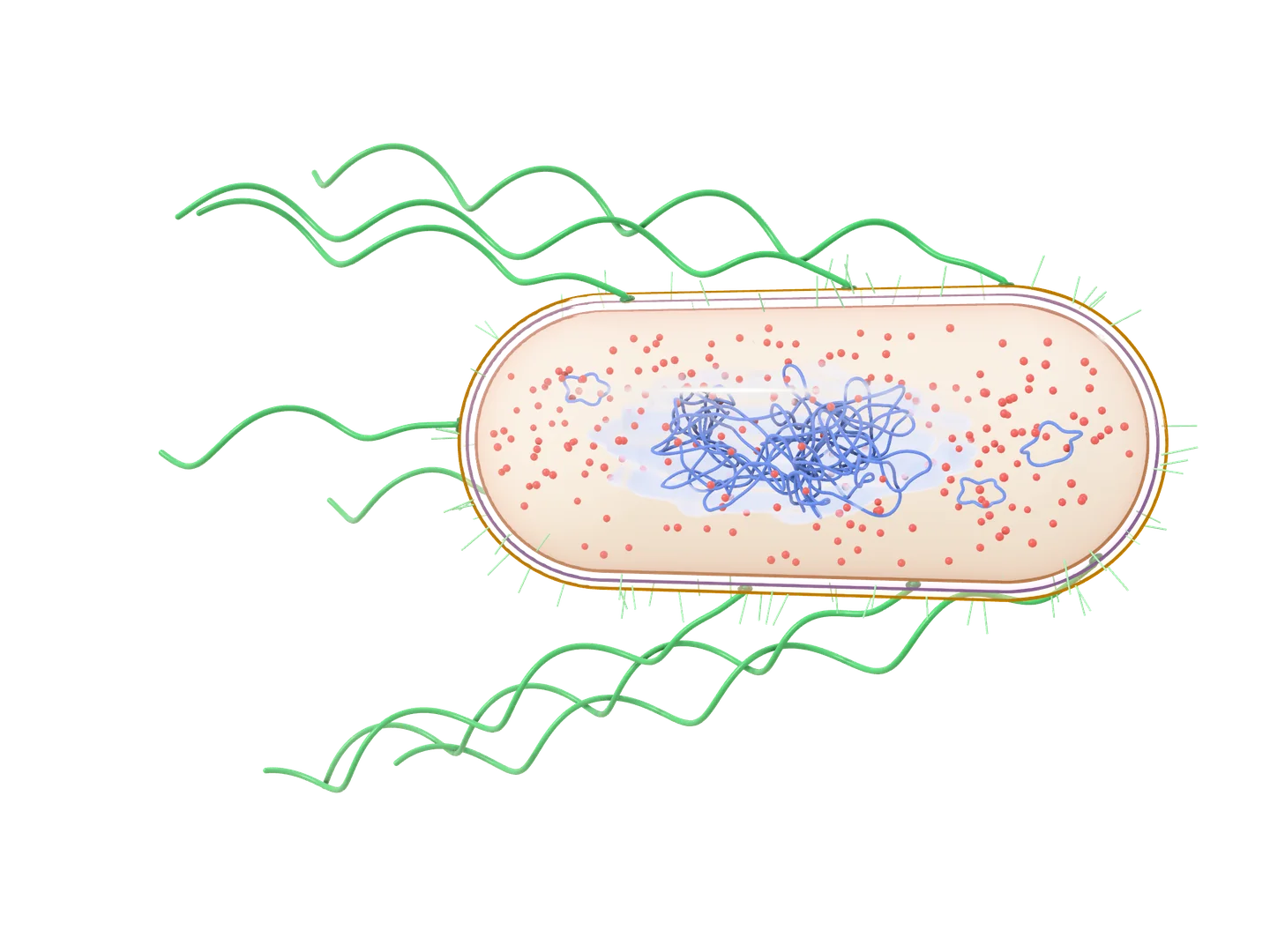
E. coli, a rod-shaped prokaryote, shown twice: as a model of the whole cell, which you can turn, and in a longitudinal section, a slice along its length. Its envelope has three layers: the outer membrane, a thin cell wall, and the plasma membrane. Inside, with no nucleus, a tangle of DNA, the nucleoid, fills the middle of the cytoplasm, with small rings of DNA, plasmids, and many ribosomes round it. Outside, short fimbriae cover the cell, and long wavy flagella rise all over it, each turned by a motor in the envelope, and stream back from it. Arrow keys turn it, plus and minus zoom, and Home brings back the first view.
Longitudinal section
Drag to turn it, pinch or scroll to zoom, and tap a part to read what it does.
E. coli, a prokaryote about 2 µm long, has no nucleus and no membrane-bound organelles: its one circular chromosome lies in the nucleoid, a region of the cytoplasm with no membrane round it. Its envelope is the plasma membrane, a thin wall of peptidoglycan and, outside that, the outer membrane of a gram-negative bacterium. Flagella, turned by motors in the envelope, drive it along, and fimbriae let it stick to surfaces and cells.
Simplified: not to scale: the envelope drawn thicker, and the flagella and fimbriae shorter than they are; the chromosome far shorter than it is: stretched out, it would be about 1.1 mm long, over 500 times the cell’s length; far fewer ribosomes than a real cell has; the flagella drawn apart, though while it swims they turn together in one bundle; in the model, the fimbriae shown only round its outline, where they stand out from it; the wall in carbohydrate’s colour, though its cross-links are peptides; the outer membrane drawn like the plasma membrane, though its outer layer holds lipopolysaccharide; ribosomes in RNA’s colour, though they are part protein.
10 sources
- Clark MA, Douglas M, Choi J. Biology 2e. OpenStax; 2018. 4.2 Prokaryotic Cells.
- Clark MA, Douglas M, Choi J. Biology 2e. OpenStax; 2018. 4.3 Eukaryotic Cells.
- Parker N, Schneegurt M, Thi Tu AH, et al. Microbiology. OpenStax; 2016. 3.3 Unique Characteristics of Prokaryotic Cells.
- Parker N, Schneegurt M, Thi Tu AH, et al. Microbiology. OpenStax; 2016. 3.4 Unique Characteristics of Eukaryotic Cells.
- Parker N, Schneegurt M, Thi Tu AH, et al. Microbiology. OpenStax; 2016. 14.3 Mechanisms of Antibacterial Drugs.
- Parker N, Schneegurt M, Thi Tu AH, et al. Microbiology. OpenStax; 2016. 9.2 Oxygen Requirements for Microbial Growth.
- Parker N, Schneegurt M, Thi Tu AH, et al. Microbiology. OpenStax; 2016. 15.2 How Pathogens Cause Disease.
- Clark MA, Douglas M, Choi J. Biology 2e. OpenStax; 2018. 7.4 Oxidative Phosphorylation.
- Clark MA, Douglas M, Choi J. Biology 2e. OpenStax; 2018. 14.2 DNA Structure and Sequencing.
- Escherichia coli. Wikipedia, citing Encyclopaedia Britannica and Kubitschek HE, J Bacteriol 1990.
The outer membrane is one reason gram-negatives are harder to reach, and some drugs are built to pass it: cefepime, for one, carries a positive charge beside its negative one, which lets it through the porins faster than other cephalosporins. It is also why the glycopeptides, far larger molecules, reach only gram-positives.
How bacteria resist
- β-Lactamases, the main way, above all in gram-negatives. They open the ring before it reaches the PBP. Gram-positives such as Staphylococcus aureus release theirs outside the cell; gram-negatives keep theirs in the periplasm. Their genes often travel on plasmids, between species.
- PBPs they bind poorly. The mecA gene of methicillin-resistant S. aureus (MRSA) codes for PBP2a, which goes on cross-linking the wall when the other PBPs are blocked. Penicillin-resistant pneumococci have altered PBPs too. In gram-positives, this is the main way.
- Less getting in. A gram-negative can make fewer porins, or change them, so less drug reaches the periplasm.
- Efflux pumps, which push the drug back out across the outer membrane.
The β-lactamases fall into four classes by their structure. Classes A, C and D have a serine in the active site; class B, the metallo-β-lactamases, use zinc.
| Class | Examples | What they break, mainly |
|---|---|---|
| A | penicillinase of S. aureus; TEM and SHV; CTX-M and other extended-spectrum β-lactamases (ESBLs); KPC | penicillins and early cephalosporins; ESBLs also later cephalosporins and aztreonam; KPC also carbapenems |
| B (metallo) | NDM, VIM, IMP | almost every β-lactam, carbapenems included, but not aztreonam |
| C | AmpC | penicillins and most cephalosporins, but not cefepime well, nor carbapenems |
| D | OXA enzymes, such as OXA-48 | penicillins; OXA-48 also carbapenems, weakly |
β-Lactamase inhibitors
A β-lactamase inhibitor binds the enzyme in the drug's place and inactivates it, so the partner reaches its PBP. Clavulanic acid, sulbactam, tazobactam and enmetazobactam are β-lactams themselves, with little antibacterial activity of their own; avibactam, relebactam and vaborbactam are not β-lactams.
| Inhibitor | Given with | Blocks |
|---|---|---|
| Clavulanic acid | amoxicillin (co-amoxiclav) | many class A enzymes, including staphylococcal penicillinase and most ESBLs |
| Sulbactam | ampicillin | class A enzymes, less strongly than clavulanate; it also has some activity of its own against Acinetobacter |
| Tazobactam | piperacillin; ceftolozane | class A enzymes |
| Enmetazobactam | cefepime | class A enzymes, ESBLs among them, but not reliably KPC |
| Avibactam | ceftazidime; aztreonam | classes A (KPC too) and C, and some D (OXA-48) |
| Relebactam | imipenem–cilastatin | classes A (KPC too) and C |
| Vaborbactam | meropenem | classes A (KPC too) and C |
None of them blocks the metallo-β-lactamases. Clavulanate, sulbactam, tazobactam and enmetazobactam don't block AmpC usefully, nor the carbapenemases.
Clinical indications
β-Lactams are among the most used antibiotics, and the family is chosen by the bacteria it has to reach. The topics after this one give each family's uses in full.
| Family | Used first for, mainly | More in |
|---|---|---|
| Penicillins | streptococcal infections (penicillin G and V) and syphilis (penicillin G); MSSA (flucloxacillin); ear, sinus and chest infections (amoxicillin, co-amoxiclav); serious infections in hospital, Pseudomonas among them (piperacillin–tazobactam) | Penicillins |
| Cephalosporins | surgical prophylaxis (cefazolin); meningitis, gonorrhoea and pneumonia treated in hospital (ceftriaxone); Pseudomonas (ceftazidime, cefepime) | Cephalosporins |
| Carbapenems | serious infections caught in hospital, and those with ESBL-producing gram-negatives | Carbapenems and glycopeptides |
| Monobactams | aerobic gram-negatives, Pseudomonas among them, in patients with a severe β-lactam allergy | Carbapenems and glycopeptides |
Where killing is needed against enterococci, as in enterococcal endocarditis, a β-lactam is given with a partner and the two kill together: ampicillin with gentamicin, or ampicillin with ceftriaxone (two β-lactams that block different PBPs).
Adverse drug reactions
β-Lactams are among the safest antibiotics, which is why so many are given. Their adverse reactions are mostly those of the whole class, and allergy comes first.
- Life-threateningAnaphylaxis. The gravest of the immediate, IgE-mediated reactions, which usually start within an hour of a dose. It is rare, in about 4 to 15 patients in 100,000.
- SeriousOther immediate reactions: urticaria, angioedema and bronchospasm, IgE-mediated too and as quick to come on. Swelling of the throat or bronchospasm can be the start of anaphylaxis, and is treated as anaphylaxis.
- Life-threateningSevere skin reactions, such as Stevens–Johnson syndrome and toxic epidermal necrolysis. Delayed, T-cell reactions, and rare.
- MildDelayed rashes, mostly maculopapular. T-cell reactions that come hours to weeks later, usually after some days, and can begin after the course has ended. A rash with fever, blisters, a sore mouth or eyes, or peeling skin is treated as a severe reaction.
- SeriousClostridioides difficile colitis. β-Lactams disturb the gut's bacteria, and C. difficile can take their place.
- SeriousNeurotoxicity at high doses, especially when the kidneys clear the drug slowly: confusion, myoclonus and seizures, most with penicillin G, cefepime and imipenem.
- SeriousBlood and kidney. β-Lactams can cause immune haemolytic anaemia, rarely fatal with ceftriaxone, and neutropenia, mostly on long, high-dose courses, so the blood count is checked on a long course. They can also cause interstitial nephritis.
Allergy and cross-reactivity
Cross-reactivity between penicillins and cephalosporins is lower than once thought. Early cephalosporins were contaminated with penicillin, which gave the old figure of 10%; it is now put at about 2%, lower still with carbapenems, and it follows the R1 side chain more than the shared ring. A penicillin and a cephalosporin with the same or a similar side chain, such as ampicillin and cefalexin, are the ones to avoid together. Aztreonam rarely cross-reacts with the other β-lactams; the clear exception is ceftazidime, which has the same side chain.
- report a penicillin allergy
- 10%of patients
- were not allergic when tested, in one series of inpatients
- 95%of them
- between penicillins and cephalosporins, set mostly by the R1 side chain
- 2%cross-reactivity
Side effects
At usual doses, what patients notice most comes from the gut, whose bacteria every β-lactam disturbs.
- MildDiarrhoea, the commonest. Diarrhoea that is severe or bloody, or goes on, may be C. difficile (above).
- MildNausea, and less often vomiting.
- MildThrush, in the mouth or the vagina, for the same reason as the diarrhoea, most often with the broader drugs, such as co-amoxiclav.
Contraindications
- ContraindicatedAn allergy to the drug's own family. A patient allergic to a penicillin is given no penicillin. One allergic to a cephalosporin is given no cephalosporin by its licence, though an allergist may allow one with a different side chain.
- ContraindicatedAnaphylaxis or a severe skin reaction to any β-lactam. After anaphylaxis, the licences of the penicillins, cephalosporins and carbapenems rule out the other β-lactams too, and the carbapenems' and aztreonam–avibactam's do after a severe skin reaction as well; plain aztreonam's asks only for care. In practice an allergist decides which other β-lactams, if any, are safe: cross-reactivity follows the side chain, and after a severe skin reaction that may be none.
- CautionA penicillin allergy label, without a severe reaction. Most labelled patients aren't allergic, so the label is checked first. A cephalosporin with a different side chain, or a carbapenem, is usually tolerated.
- CautionKidney failure. The doses of most β-lactams are cut, or they build up toward neurotoxicity. The exceptions are those cleared partly in bile, such as ceftriaxone.
- AvoidValproate, with a carbapenem. Carbapenems cut valproate levels by 60 to 100% within about two days, and raising the valproate dose may not make up for it. Another antibiotic is chosen, or, if a carbapenem is needed, another anticonvulsant is added.
- CautionMethotrexate, with a penicillin. Penicillins slow its excretion and can make it toxic, so its levels are watched.
- CautionWarfarin. Amoxicillin and ceftriaxone can raise the INR, so it is checked when the antibiotic starts and when it stops.
Pregnancy and lactation
Penicillins and cephalosporins are among the antibiotics of choice in pregnancy, which many other antibiotics are not, and are used in breastfeeding too.
- CompatiblePenicillins in pregnancy. Penicillin V, amoxicillin and co-amoxiclav are commonly prescribed, with no concern that they harm the baby, and no extra monitoring needed afterwards. The broader ones, such as piperacillin–tazobactam, have fewer data.
- CompatibleCephalosporins in pregnancy. Most studies show no harm to the baby. An occasional link with heart defects after use early in pregnancy is not borne out by most studies.
- AvoidCo-amoxiclav when the membranes rupture before term. Given to prevent infection after preterm prelabour rupture of the membranes, it was linked to necrotising enterocolitis in the newborn, so another antibiotic is used.
- CautionCarbapenems in pregnancy. There are few human data. Animal studies of meropenem and ertapenem show no harm, but imipenem–cilastatin increased embryo loss in monkeys. They are kept for serious infections that need them, and meropenem's licence prefers to avoid it, as a precaution.
- AvoidAztreonam in pregnancy. There are few human data, though animal studies show no harm. Its licence lists pregnancy as a contraindication, yet allows it when clearly needed, so another drug is used if one will do.
- CompatibleBreastfeeding. β-Lactams pass into milk in small amounts, and those given only by injection, such as ceftriaxone and the carbapenems, are barely absorbed from the baby's gut. The baby may get diarrhoea or thrush, and rarely a rash.
Check yourselfAnswer, then say how sure you were: a lucky guess still counts as a weak point.
1What do β-lactam antibiotics bind to kill a bacterium?
2Which measure best predicts how well a β-lactam kills?
3How does MRSA resist nearly all β-lactams?
4What does clavulanic acid add to amoxicillin in co-amoxiclav?
5A patient's notes say "penicillin allergy" after a rash in childhood. What is most likely?
6A woman 12 weeks pregnant has a urinary infection that amoxicillin or cefalexin would treat. What is known about these two families in pregnancy?
Linked topicsThe concepts this topic shares, and the topics they tie it to.
See on the mapBacterial cell wall
A β-lactam binds the penicillin-binding proteins, so new peptidoglycan isn’t cross-linked.
- Origin and evolution of cells. Prokaryotes, eukaryotes, Escherichia coliBiologyProkaryotes such as E. coli, and the cell wall our cells lack.
- Antibiotics: classification; mechanisms, type and spectrum of action. Principles of the rational antibiotic therapy and prophylaxisAntimicrobials and chemotherapeuticsAntibiotics are grouped by their target; the cell wall is one of the main ones.
- PenicillinsAntimicrobials and chemotherapeuticsThe first β-lactams, from benzylpenicillin to amoxicillin and piperacillin.
- CephalosporinsAntimicrobials and chemotherapeuticsβ-lactams in generations: the first three reach ever more gram-negatives, the fifth MRSA too.
- Carbapenems and monobactams. GlycopeptidesAntimicrobials and chemotherapeuticsCarbapenems are the broadest β-lactams; vancomycin blocks the wall by binding D-Ala-D-Ala itself.
- Bacterial community – acquired pneumoniaInternal medicineAmoxicillin treats most pneumococcal pneumonia.
- EndocarditisInternal medicineWeeks of intravenous β-lactams, or vancomycin, chosen by the organism.
- Hospital – acquired pneumonia and pneumonia in immunocompromised patientsInternal medicineCeftriaxone or ertapenem if resistance is unlikely; piperacillin–tazobactam or meropenem if it is likely.